
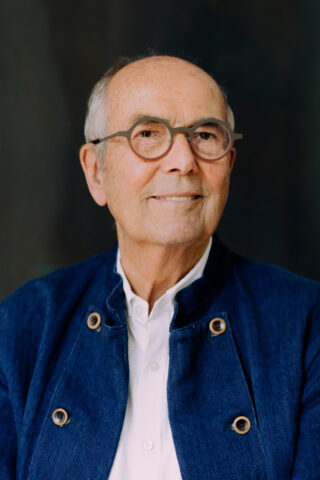
 Mr. Hans Schöpflin, how would you describe yourself – as entrepreneur, founder – as human being?
«I see myself as a businessman and philanthropist, but above all as a person that has evolved through numerous metamorphoses. I come from a business family, so I had the entrepreneur bug. I started out as an executive and then made my way to become independent.
Then came a fork in the road of my life. Life of course has its ups and downs. It led me to ask myself: What is it to be successful? What is it to be financially successful? And that led me to consider how to make myself a part of a functioning civil society and especially consider what role philanthropy can play in this context.
I ended up merging entrepreneurship and philanthropy, applying my business experience to the philanthropic context. In summary, I’m still a businessman, but I’m not just a philanthropist. I’m an activist philanthropist and I’m applying business principles in the realm of philanthropy. This means you take risks; you believe in dialogue, you believe in people».
What experiences or turning points in your life have shaped your current attitude toward social responsibility?
«Well, the fork in my road, so to speak, was when my son Axel tragically died at the age of 19 because of an heroin overdose. That was obviously life-changing. There were a lot of questions I asked myself and others, and I was also confronted with questions by others within the family. There were accusations: Maybe you were too focused on your business interests and did not spend enough time with the family or with your son? Obviously, all of this is somehow true. This was a crucial awakening for me. I asked myself: What is the meaning of life? What is the meaning of success? How much is enough? Buddhism helped tremendously in my evolution as a human being in this context.
Then I engaged in philanthropy by setting up my first foundation, Panta Rhea, in the late 1990s in the US. In 2001, I set up the next foundation in Germany together with my brother and sister, the Schoepflin Stiftung, and in 2023 a further foundation, Spore Initiative, opened its doors.
Spore is not just another grant-giving foundation, but it was conceived as a space for dialogue and community-building, focusing especially on issues to do with ecosocial justice, culture, and education».
Were there any individuals who particularly inspired or influenced you in your development, either in your personal or professional life?
«Yes, I can point very precisely to two individuals when I entered business. The first one was a German entrepreneur, that identified me and appointed me to become his deputy for his expansion to the US. Then, in the US, I found my second mentor. We were all young executives and this individual was our elder. We learned tremendously from him as a human being. He was a brilliant businessman, but at the same time he was also a totally committed philanthropist. He demonstrated to us early: You always give back. Without these two experiences I could never have become the person that I am today».
What motivated you to establish the Schöpflin Foundation, and what goals do you hope to achieve with this decision?
«The Schöpflin foundation was driven by the fact that my brother and my sister were very supportive during this very difficult time when our son died. We had a property where we all grew up, but which had fallen into disuse. It was an old villa in a wonderful park. So, I said, look, what can we do with this asset? Serendipitously, this property became an ideal home for our foundation focused on the issue of prevention.
There are obviously various forms of addiction, alcohol, drugs – today we have already expanded it to the addiction to the digital media. Anyhow, we all contributed as siblings to this property, and we went as co-Founders into the foundation. Considering prevention, we honed in on a real issue at that time: Alcopops. This was kind of epidemic in Germany in 2001 and 2002. Kids, boys and girls, at the age of 13, 14 ended up in the hospital because of alcohol poisoning, some of them died, some of them found the way back. With that issue, we found our cause. Without knowing what it all means we set up the Center for Drug Prevention in 2002, the Villa Schöpflin. Since then, we are really sailing from one successful intervention to the other and are now active throughout Germany in various programs. The latest project is about preventing digital addiction and promoting the responsible use of digital media and has recently developed an app».
Which projects or topics are particularly close to your heart, and why?
«The first one is democracy, and the second one is young individuals, starting with children all the way up to young adults. These two are for me the two sides of the same coin. Our democracy can only stay alive if the younger generation has the consciousness about what it means to live embedded in democratic values, in the notion of the French Revolution: liberté, égalité, fraternité. That is the common denominator for what we’re doing».
What developments would you like to see for the foundation in the coming years—both in terms of content and structure?
«What makes us tick is that we are curious. We are always trying to look around the corner, what is next. We’ll voice the challenge and identify problems maybe before the mainstream discovers them. We are good at going out and finding partners: Individuals that have a conviction, curiosity and the backbone to go through difficult phases. Individuals who sometimes make mistakes but recognize them and get up again. We just celebrated the 10-year-anniversary of an NGO that has survived (Kiron), that is thriving and has reinvented itself more than once. That’s all part of this legacy that comes from my business experience of venture capital where you learn how to deal with change, new facts and new situations».
What is your greatest wish for the future of the foundation and for society?
«The foundation is set up to be there forever. This was a very deliberate decision. I discussed it with my daughter, Lisl, who is now stepping up to the plate and who has challenged me in this regard. She said, there are such problems in our societies, shouldn’t we spend it down, is it now or never? But I think it’s our responsibility to also make sure that those that come after us have a basis to stand up and to fight. I believe in process, in growth and in evolution. That’s what we’re trying to live by.
On the other hand, when it comes to society, I’m very much aware of the dangers associated with artificial intelligence. We see the beginning of a world with tech-dominated society, run by a few tech oligarchs. Will they grab power and have dominance because they have all the money in the world? I absolutely believe in diversity, but it is under enormous attack right now. Everything is being concentrated in a few hands by autocrats. My wish is that in the long run humanity will remember that diversity beats monoculture».
Borse di studio, la Fondazione Tarchini rafforza il sostegno agli universitari ticinesi