
 Born in 1994 from the vision of Nicolas G. Hayek, founder of Swatch, and the automotive expertise of Mercedes-Benz, smart has transformed urban mobility into a design phenomenon. After conquering cities with the unmistakable fortwo, the brand embarked on a profound evolution. Since 2019, the joint venture between Mercedes-Benz AG and Geely Holding has given new impetus to development, ushering in an all-electric phase and an increasingly assertive presence in the premium segment. Styling remains entrusted to the Mercedes-Benz Design team, while the collaboration with BRABUS brings a distinctly sporty edge to the range. Today, the European offering includes three electric SUVs—#1, #3, and #5—different in size and purpose, but united by a consistent design language. And a return to its roots is already on the horizon: the new two-seater #2 will be unveiled at the Paris Motor Show in October 2026, ahead of a market launch in 2027.
At 4,27 meters, the smart #1 is the most compact model in the range and the one that most immediately embodies the brand's traditional urban vocation. Its compact proportions, short overhangs, and soft surfaces give it an elegant and contemporary presence; the 2,75-meter wheelbase, meanwhile, offers surprising interior space for its compact size. The essential and enveloping dashboard is dominated by the central display, while the raised tunnel increases the storage space and accentuates the sense of quality. The rear-wheel drive versions have 272 hp, with 47 or 62 kWh net batteries and WLTP ranges of between 310 and 440 km. At the top, the #1 BRABUS combines two engines and all-wheel drive to produce 428 hp, enough to accelerate from 0 to 100 km/h in 3,9 seconds.
Longer and sleeker, the smart #3 translates the same principles into an SUV coupé body. Measuring 4,40 meters, it combines a generous 2,79-meter wheelbase with a sloping roofline, frameless doors, and a large panoramic roof: elements that enhance its sophisticated character without compromising everyday usability. The more favorable aerodynamics also contribute to efficiency: with 47 or 62 kWh net batteries, the WLTP range varies from 325 to 455 km. The single-motor, rear-wheel drive versions deliver 272 hp; the #3 BRABUS, with dual motors, all-wheel drive, and 428 hp, brings a decidedly more dynamic feel to the range.
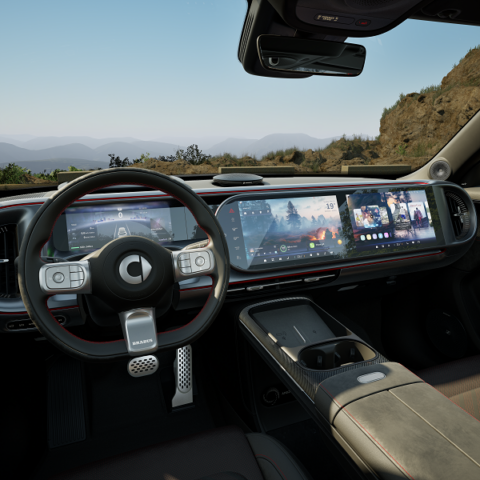
With the smart #5, the brand enters the mid-size SUV segment. Its 4,70-meter length and 2,90-meter wheelbase translate into a generous and versatile interior, with a trunk of up to 630 liters. The design becomes more assertive, while retaining the clean surfaces and distinctive details of the smart family. On board, the 10,25-inch instrument cluster is flanked by two 13-inch OLED screens, one central and one for the passenger. The range starts with a 76 kWh battery; from the Pro+ versions onwards, it adopts a 100 kWh gross battery (94 kWh net) and an 800-volt architecture, capable of accepting up to 400 kW of direct current and increasing from 10 to 80 percent in 18 minutes in ideal conditions. The range reaches 590 km WLTP. Rear-wheel drive versions develop up to 363 hp, while all-wheel drive versions develop up to 588 hp; The #5 BRABUS peaks at 646 hp and 710 Nm, with a 0-100 km/h time of 3,8 seconds. Thus, the new smart model extends beyond the city without sacrificing design and character.