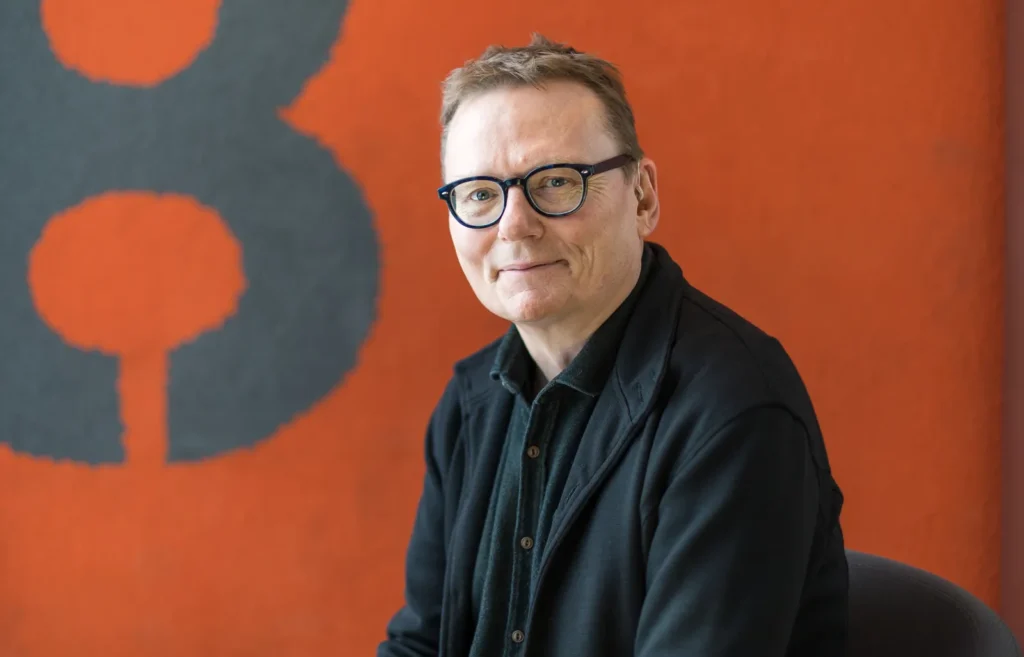
Daron Acemoglu's research encompasses themes of democracy, power, technology, and development, making him a central voice in modern economic thought. Growing up in Istanbul in the shadow of a military coup, Acemoglu developed an obsession from an early age with the concept of power, who wields it, and its impact on the overall prosperity of a country and its people. Turkey's economic, political, and institutional instability was not abstract. It shaped the choices available to families, workers, and children. As a teenager, he looked to economics for answers. What he found instead was a discipline reluctant to discuss democracy, history, or power. "I didn't know economics didn't really address these questions," he says. But instead of abandoning it, Acemoglu made them central to his life's work.
Daron Acemoglu
Born : 1967, Istanbul, Turkey
Field : Political economy, economic history
Awarded : Sveriges Riksbank Prize in Economic Sciences in Memory of Alfred Nobel, 2024
Award-winning work : For studies of how institutions form and influence prosperity
The greatest luxury : free time, of which he doesn't have much
Professionalism : He is one of the most cited economists.
What are the causes of the global gap between rich and poor countries?
In a globalized world, how is it possible that there is such a wide gap between rich and poor countries? For Acemoglu, this has remained one of the thorniest questions, both as an economist and as a human being. People around the world have access, in theory, to the same technology and the same flow of information, yet "the 10 richest countries have a per capita income 60 times higher than that of the poorest countries," he says. "It's a simply staggering gap. How to make sense of it, I believe, is one of the most important questions in social science, and it also helps us navigate important institutional issues."
Acemoglu, along with his co-graduate students and longtime collaborators James Robinson and Simon Johnson, has emphasized the analysis of the inclusion or extraction of institutions. Their research has clearly demonstrated that inclusive institutions—the rules that determine who gets what and under what conditions—are at the heart of why some countries grow rich while others remain poor. Inclusive institutions offer people both incentives and opportunities. They foster broad participation, reward innovation, and adapt to change. Extractive institutions do the opposite. They accumulate power, stifle initiative, and block dissent, even at the direct expense of prosperity.
Why do powerful elites resist economic and political change?
A central part of this research was also the identification of resistance, both institutional and technological. At the heart of Acemoglu's theory is a harsh truth: those in power often resist change, even when it could enrich them.
This resistance, be it economic, political, or social, is not random. It is systemic. Monopolies fear competition. Dictators fear emancipation. A new technology may promise growth, but if it threatens to democratize information, change labor dynamics, or encourage opposition, it becomes dangerous for those in power. What this insight demonstrates is that development does not fail for lack of ideas, tools, or even resources. It fails when elites believe repression is safer than reform. This resistance manifests itself in moments of profound transformation. Wars, plagues, revolutions, and new technologies destabilize established orders. Acemoglu calls them "critical junctures," turning points where institutional paths diverge.
What are the critical moments and how do they alter the course of development?
"Third junctures destabilize existing orders and create an imbalance between existing institutions and people's aspirations," he says. "When this happens, you reach a crossroads, so to speak. Either you allow some of these changes to occur, or you have to intervene with very forceful measures to counter them. So, critical junctures are great amplifiers of inequality and are the handmaidens of institutional change." Industrialization was one such phase, as was colonialism, according to Acemoglu. "When you fall behind, it becomes very difficult to build better institutions," he says. Critical junctures significantly amplify inequality and are the handmaidens of institutional change.
What is the narrow corridor theory of democracy and state power? In their second book, "The Narrow Corridor," Acemoglu and Robinson expanded on their research, arguing that freedom arises not from the absence of state power, but from its balance with a society endowed with power. Too little state, and chaos reigns. Too much, and tyranny takes over. The pair's "narrow corridor" concept seeks to capture this tension. "Democracy and freedom are natural companions, but they are not the same," Acemoglu states. "Democracy is a very complex concept. On the one hand, we want people to be free from the worst forms of coercion and abuse. But on the other hand, freedom also has an enabling element."
This enabler requires strong institutions that provide services like education, healthcare, infrastructure, and protection from violence. But institutions must also have constraints, otherwise they risk becoming predatory. "You want the capacity of any institution, third party, elite, or leader to be limited," he says. "You want the state, but it must be strongly constrained, so that it cannot do what states have done throughout humanity." Maintaining this balance in the narrow corridor requires constant recalibration, especially in the face of crises like climate change or digital authoritarianism.
Democracy and freedom naturally go together, but they are not the same thing.
Once delegated, power is used for many purposes, and even democracy itself can be unstable. Acemoglu sees this phenomenon unfolding in many parts of the world right now and believes it could represent the critical moment of our times. "Both liberal democracy and freedom are in danger due to economic and cultural tensions," he says, but warns that three specific factors are particularly dangerous when concentrated. "One is wealth. The other is power. And the third is information. And right now, we are increasingly concentrating all three in the hands of a small group of people."
The risks and benefits of technology
From British weavers destroyed by mechanization to today's self-employed workers replaced by artificial intelligence, Acemoglu argues that the benefits of any new technology depend on its design and the institutions that shape its use. Acemoglu and Johnson challenge the assumption that technological progress is automatically positive for everyone in their book "Power and Progress," because, historically, it hasn't been. They distinguish between automation, which often reduces opportunities, and task creation, which increases human capabilities. The key, according to Acemoglu, is to choose technologies that empower workers, not simply replace them.
The role of institutions in freedom
What are Acemoglu's concerns about artificial intelligence and digital power? Today, AI is often considered a sacred technology, and Acemoglu doesn't necessarily disagree, but he cautions against techno-optimism. "I think all digital technologies, including AI, pose two distinct sets of threats," Acemoglu says. "One is that, if they create unemployment and inequality, they will deepen social tensions and make democracy more difficult to implement. Second, they are information technologies, and whoever controls information controls information."
According to Acemoglu, redirecting technological change toward the creation of new tasks, rather than eliminating automation, is a way to ensure the creation of systems that promote shared prosperity. "Artificial intelligence offers numerous possibilities for improving human skills, enhancing human capabilities, creating new tasks and new services for humans," he says.
Institutions should be updated as technology advances, but the same goes for the questions we ask about the direction of technology and the power institutions have over those who drive it. "Institutional elements and the direction of technology are both crucial, which is why new technologies require new debates," he says. "It's a very difficult balance. And when in doubt, I believe we should err on the side of distrust and let the market do its work, because we have many examples of historical societies that sought to control technology and, as a result, became barriers to technological developments and led to large-scale underdevelopment."
Whoever controls information technology controls information
Despite the challenges, Acemoglu isn't particularly worried. He draws hope from history, particularly from societies' ability to self-correct. From the reform of industrial Britain. From the Latin American democracies emerging from dictatorship. Even amid today's turbulence, he sees the possibility of new ideas, new institutions, and new coalitions.
How can education, participation, and new ideas foster positive change? "An informed and active citizenry is more important than ever," he says. "Citizens must care about technology, power, information, and work. All of this requires flexibility. We must be adaptable as individuals, as a society." To achieve this, education is important. Participation is important. But above all, ideas are important. New technologies require new narratives, new frameworks for thinking about inclusion, productivity, and power. "We need new ideas to defeat bad ideas," he says. The future, in other words, is not just something to be inherited in Acemoglu's mind; it must be built and contested.
We should never lose hope, especially hope in the creativity, adaptability, and versatility of human beings.
When asked if he's optimistic, Acemoglu makes a clear distinction. "There's a fine line between optimism and hope," he says. "Optimism blinds us. But we should never lose hope, especially hope in the creativity, adaptability, and versatility of human beings."
It's not a sentimental hope, but a deeply empirical one. It highlights humanity's achievements in recent centuries. "We have built societies of hundreds of millions of people who, for the most part, have lived in peace and in ways that have created new paths to realize their dreams and build prosperous, healthy, comfortable, and free lives," he says. "It's simply an extraordinary achievement."
What is Daron Acemoglu's message to the next generation of thinkers and leaders? Acemoglu teaches his students, his children, and his peers with the weight of history and the urgency of the present in mind. His advice to the next generation is both simple and demanding: stay alert, curious, and engaged. Acemoglu himself finds inspiration in unexpected places, like a newspaper quote, sometimes in a song or a film, or in an old historical document.
"We're living in unusual times, so there's no natural roadmap," he says. "We need to be open to both dangers and opportunities." This openness to debate, trials, and transformation is perhaps his most enduring commitment.
Courtesy of UBS Nobel Perspectives.