
 From Prampolini's futurist and multi-material works to Burri's powerful works, the exhibition highlights how the use of matter has given voice to the anxieties of a complex historical period, revealing all its violence and transgressive force.
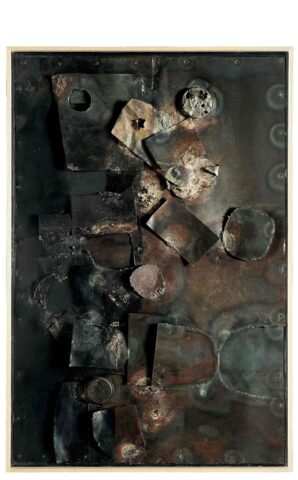
The exhibition, curated by Gabriella Belli and Bruno Corà, in collaboration with the Burri Foundation of Città di Castello, and designed by Mario Botta, presents a wide variety of materials, from sponge to cork, which increasingly limit the space previously dominated by painting—an expression of Enrico Prampolini's disobedience to traditional techniques—and Alberto Burri's humble, raw material, which replaces color, stripped of all possible metaphor. This result stems from Burri's search for a new language in the aftermath of the Second World War, a period he experienced firsthand as a medical officer, a prisoner in Africa, and then in Hereford, Texas, before becoming a self-taught artist.
If Prampolini – an eclectic futurist in contact with the most important European avant-gardes – was already experimenting with the potential of polymaterialism in 1914, Burri, who represents the second half of the XNUMXth century in the exhibition, proposes matter in the most radical poetic key.
"The paths taken by Prampolini and Burri, with conceptually different trajectories and meanings," explain Gabriella Belli and Bruno Corà, "point to possible paths, certainly not the only ones, but certainly the riskiest, those that, abandoning painting as a pure medium of centuries-old tradition, rely on something completely different: cutting and pasting, digging into the earth, using plastic, sacks, mold and burning, adding objects, and much more. A linguistic revolution that would become, as is well known, an international norm and style in Burri's work, with a European primacy that is worth reflecting on."
 A radical exhibition space, conceived for the occasion by Mario Botta in two successive and separate moments, will host the exploration of Prampolini's and Burri's two distinct yet dominant visions of matter through contrasting color choices: white walls for Prampolini's works, completely black for Burri's.
Among Prampolini's creations on display in Lugano is Interview with Matter , an authentic manifesto from 1930 that inaugurates the most deeply visionary and cosmic phase of his production. Unprecedented metamorphoses of forms unfold in works such as Mechanical Venus , 1930, or the magnificent Aerodynamic Geometry , 1934–1935, while Forme forza nello spazio , 1932, is a powerful depiction of alien worlds dominated by geometry amidst new psychic forces of organic forms. The last multi-material paintings on display in Lugano date back to the 1950s, such as Abstract Composition CR , 1954.
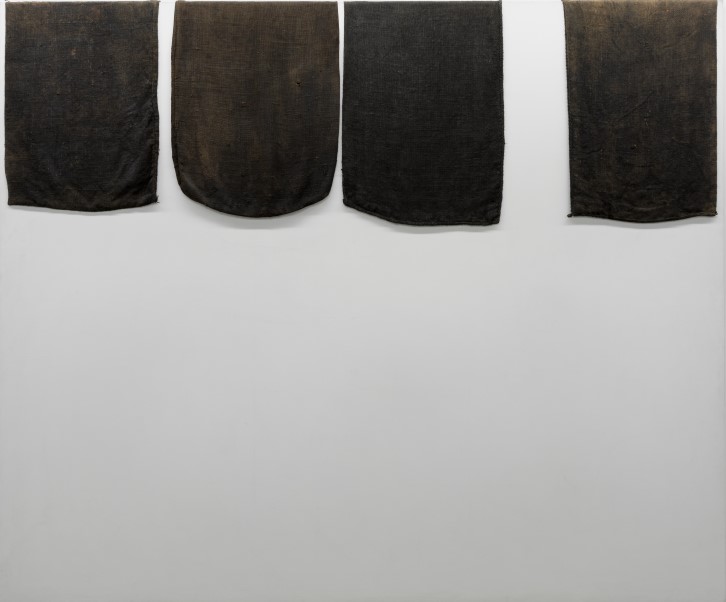
With his intuitive concepts, Burri remains distant from Prampolini's theories. The exhibition in Lugano presents various works, from the cycles of the early years, to the Composizioni , to the Catrami of 1948-1950, up to the Sacchi , masterpieces that bring the master's art towards a definitive material dimension.
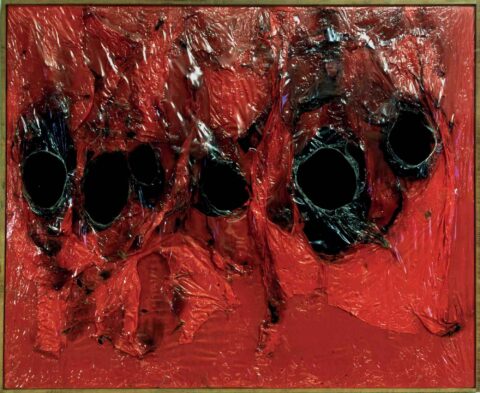 After experimenting with a wide variety of materials—from tar to pumice stone, from gold to plaster—the artist resorts to fire in the formative action of his work. The works on display, including Plastic and Red Plastic, 1962, are the results of an incessant intervention carried out by the artist with the flame dispenser in his hand on the canvas, on the plastic and the vinyl glue or on the aluminium, while he attacks and opens passages, burns central areas and edges, revealing an unknown material territory.
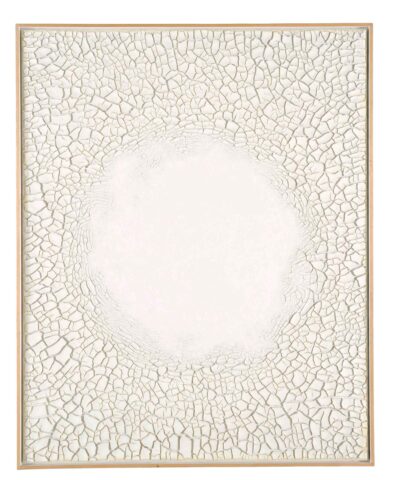
But it is through the famous Cretti that Burri moves on to the elaboration of earth, air, and water. A new manifestation of material spatiality appears in rare works from the 1970s, such as Bianco Nero Cretto , 1972, or Bianco Cretto C1 , 1973. The exhibition concludes with some works in cellotex from the 1980s and 1990s, such as Cellotex , 1980, and Nero e Oro , 1993. This wood composite, used in an industrial context, in Burri's hands comes to visualize the dimensions of silence, darkness, emptiness, fullness, and absence—all new aesthetic coordinates that will influence some of the most advanced subsequent research.