
 “I am a painter.” Jannis Kounellis repeated this statement several times throughout his long career, even when his works no longer featured canvases, brushes, and paints, but rather sheets of iron, jute sacks, coal, stones, flames, coats, fragments of furniture, and traces of smoke. It is precisely from this simple yet radical declaration that the exhibition organized by Giancarlo and Danna Olgiati Collection of Lugano, scheduled from September 20, 2026 to January 17, 2027.
For the first time, the project systematically adopts painting as the primary interpretive tool for the work of the Greek-born Italian artist. It's not about confining his work to a traditional technique, but rather recognizing painting as a way of observing, organizing, and transforming reality, giving things a new visual, symbolic, and emotional weight.
Born in Piraeus in 1936, Kounellis moved to Rome in 1956, choosing Italy as the place for his education and subsequent artistic career. In the capital, he attended the Academy of Fine Arts and encountered a cultural scene influenced by the legacy of the avant-garde and the first explorations aimed at transcending traditional painting.
His early works were still on canvas, but already contained the foundations for later developments. Enlarged letters, numbers, and signs, inspired by the writings he observed on packing crates and the sides of ships in the port of Piraeus, entered the composition like fragments of an urban alphabet, anonymous and universal.
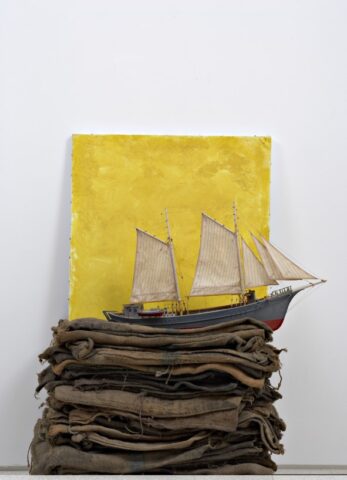 From the mid-1960s, painting gradually began to emerge from the surface of the canvas, occupying real space and involving materials, architecture, and living presences. It was during this phase that the artist approached the experiences later grouped together under the name Arte Povera, the movement theorized by Germano Celant in 1967, of which Kounellis became one of the most authoritative exponents.
His research, however, does not end there and cannot be limited to the use of "poor" materials alone. Iron, coal, wool, coffee, wood, lead, and jute were chosen not for their humility, but for their ability to preserve memory, evoke work, travel, industry, toil, the Mediterranean, and European history.
The Lugano exhibition therefore aims to transcend the more common interpretation of Kounellis as a protagonist of Arte Povera, a master of installation, or a poet of matter, restoring continuity to a path that has remained, in its essence, profoundly pictorial. As the curator suggests, the Greek term zográfos , which can be translated as "painter," literally means someone who writes or describes life.
From this inspiration was born the idea of an artist who continued to paint even after abandoning the canvas: with iron and coal, with fire and smoke, with jute sacks and the scent of coffee, but above all with space, silence, and memory.
The exhibition brings together over thirty-five works, some of which have never been exhibited before, created from the late 1950s until 2016, shortly before the artist's death in Rome in February 2017. This is not a retrospective arranged in strictly chronological order, but rather a constellation of works and references.
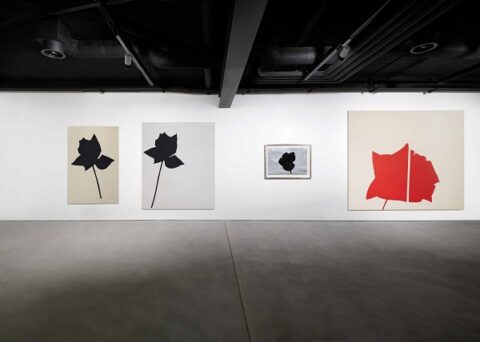 The installation connects distant moments in Kounellis's career, bringing to light themes that recur, transform, and take on different meanings: the relationship between matter and weight, language and sign, memory and silence, theater and image, presence and absence.
Even when he abandoned traditional representation, Kounellis continued to compose images. Metal sheets became pictorial surfaces; coal introduced a dense, absolute black into the space; fire produced light, heat, and transformation; sacks and coats evoked bodies no longer present; doors and windows staged a threshold, a passage, a separation.
The objects retained their identity, but were removed from everyday use and inserted into a new visual syntax. Even the installations thus acquired a strong theatrical dimension. Kounellis looked to Greek tragedy, music, and Mediterranean culture as a living heritage, capable of questioning the present.
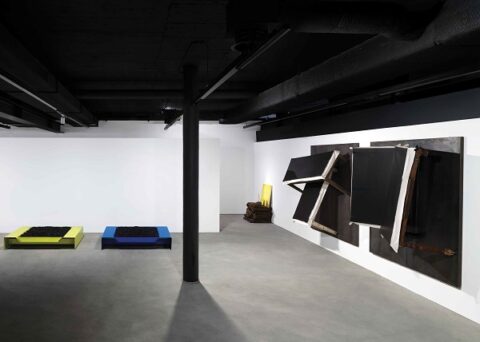 The works are not stage sets to be observed from a distance, but places the viewer is invited to enter, physically engaging with the material, the scale of the setting, and the weight of the story. The visitor, therefore, does not simply observe, but passes through a space constructed by the artist and becomes part of the composition.
"I Am a Painter" offers an opportunity to approach a central figure in twentieth-century art through a new critical perspective, yet one that remains faithful to his words. The painting evoked by the title does not coincide with a discipline or a set of tools, but with the desire to give form to experience, making visible what normally remains hidden: the passage of time, the stratification of memory, the fragility of civilization, and the silent strength of things.