
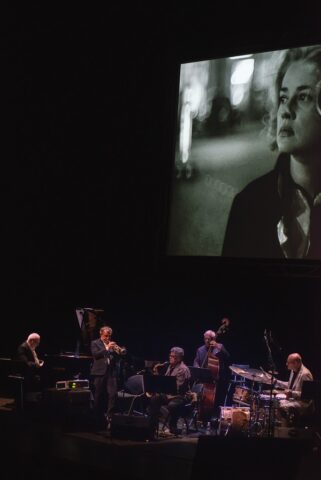
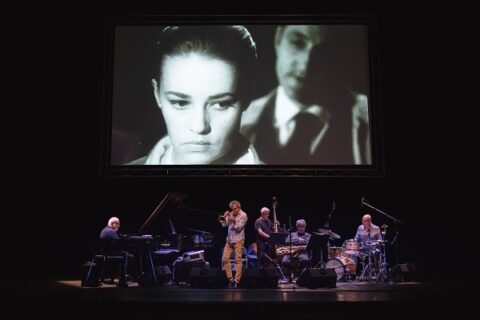
 The relationship between jazz and cinema returns to the center of the LAC Lugano Arte e Cultura program with an event that combines a 1958 film with live music. Saturday 19 September 2026, at 20.00 pm, the Theatre Hall will host the Paolo Fresu Quintet for a film-concert dedicated to Elevator to the gallows (Elevator to the scaffold) by Louis Malle.
The project wasn't born from the intention of simply re-proposing a famous soundtrack. On the contrary, it stems from an essential element of its genesis: the music composed by Miles Davis for the film wasn't constructed following a traditional score. It was improvised directly in front of the images, during a long work session in Paris.
It is precisely this process that Paolo Fresu and his musicians intend to recover, making the projection not only the backdrop to a concert, but one of the elements with which the music will interact in real time.
A film born in the heart of the Parisian night
Elevator to the Gallows tells a crime story set in a nocturnal and suspended Paris. A man gets stuck in the elevator of the building where he has just committed a murder. Meanwhile, Florence, played by Jeanne Moreau, travels the city in search of the man she loves.
Malle's film, made in the late 1950s, has become a benchmark for French cinema of the period. However, the music also played a key role in shaping its identity.
When Malle brought in Miles Davis, the American trumpeter was in Paris with some of his musicians. The solution chosen for the soundtrack was far from conventional: the images were projected, and the group played while directly observing what was happening on the screen.
There was no fully defined composition to follow. The music took shape as it was performed, reflecting the film's moods, movements, pauses, and tensions.
The result would become one of the most significant examples of the encounter between jazz and cinema.
 Paolo Fresu does not want to reconstruct a copy
The project presented in Lugano addresses that experience without attempting to reproduce it note for note. For Fresu, such an attempt would contradict the very nature of Davis's music.
The goal is rather to start from the original creative mechanism, recovering a dynamic relationship between images and sounds.
"Rediscovering situations and colors similar to those created by Miles, a shifting relationship between sound and image in which improvisation remains crucial," explains the Sardinian trumpeter.
The issue, therefore, is less about faithfulness to the 1957 recording and more about the possibility of recreating those artistic conditions today. The film remains unchanged, while the music is re-produced each time.
This is a fundamental difference. A film preserves images and editing in their final form; a live musical performance, on the other hand, is never identical to the previous one.
The reference remains Générique
The original soundtrack features a key reference point, "Générique ," the theme that helps define the film's musical direction. Davis and his collaborators built a series of improvised interventions around this element.
Malle had provided some basic instructions, but left ample space for direct interaction with the images.
Fresu considers this very method to be the core of the work to be revived. "It lasted only one night and was entirely improvised," the musician recalls, emphasizing the lack of a written score.
The contemporary challenge therefore consists in maintaining that freedom without transforming the concert into a simple historical reenactment.
When the film becomes an open score
The LAC event is part of a broader reflection on the relationship between cinema and live music. The two languages share a temporal dimension, but they manage it differently.
Cinema creates a sequence of images that cannot be altered during the screening. A concert, on the other hand, retains an element of unpredictability. The pace can change, a pause can expand, the intensity can vary, and the interaction between the musicians can produce different results.
The cine-concert was born precisely from this contrast.
In Lugano, audiences will therefore see a familiar film, but accompanied by a soundtrack that cannot be considered definitively fixed. The same film may take on different nuances depending on its performance.
The Quintet next to Fresu
Sharing the stage with Paolo Fresu will be the trumpeter's band, with which he continues his project. The Quintet includes Tino Tracanna on tenor and soprano saxophones, Roberto Cipelli on piano and electric piano, Attilio Zanchi on double bass, and Ettore Fioravanti on drums.
A training in which improvisation can develop through the interaction between different instruments, keeping the projected images as a reference.
Fresu's trumpet and flugelhorn will therefore be inserted into an ensemble in which piano, saxophone, double bass and drums will contribute to the construction of a new musical reading of the film.
A project that continues the LAC's research
Elevator to the Gallows isn't an isolated event in the LAC's programming. The film-concert is part of a journey begun last season and destined to continue in the new season.
The next choice will be Blade Runner , another film in which the relationship between images and music allows us to question the function of the soundtrack when it is brought back to the dimension of a concert.
The perspective is therefore to consider the concert film as a true artistic format, capable of questioning the traditional separation between cinema and concert hall.
The soundtrack, in this context, is no longer simply a recorded element permanently associated with a film. It returns to being an experience performed in the present.
A meeting between two eras in Lugano
The September 19 event thus connects at least three different moments: the cinema of Louis Malle from the late 1950s, the historic musical experience of Miles Davis, and the contemporary reinterpretation of Paolo Fresu and his Quintet.
The result doesn't rely on nostalgia. Davis's music is the starting point, not a model to be mechanically replicated.
Indeed, temporal distance becomes an integral part of the project. Malle's images remain the original ones, while the musical language is subjected to a new interpretation.
In this sense, the cine-concert allows us to observe how much a work can change when one of its fundamental elements is once again entrusted to live performance.
Information
The appointment with Paolo Fresu in Lugano is scheduled for Saturday 19 September 2026 at 20 pm , in the Sala Teatro of the LAC Lugano Arte e Cultura.
Louis Malle's Elevator to the Gallows will be screened in its original French version with Italian subtitles.
The project is carried out as part of Vicenza Jazz 2026.
On stage:
- Paolo Fresu, trumpet and flugelhorn
- Tino Tracanna, tenor and soprano saxophone
- Roberto Cipelli, piano and electric piano
- Attilio Zanchi, double bass
- Ettore Fioravanti, drums
Information and advance ticket sales are available on the official website of LAC Lugano Arte e Cultura.
LAC Lugano Art and Culture
Bernardino Luini Square 6
CH – 6901 Lugano
Tel 41 (0) 58 866 4222
Opening hours: Tuesday-Friday 11:00-18:00; Saturday-Sunday 10:00-18:00