
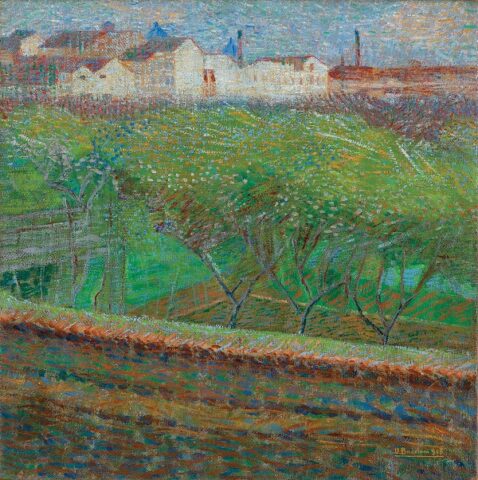
 There are moments in the history of art when the journey matters almost more than the destination. These are the years in which an artist experiments, changes direction, and continually questions what he has just achieved. This is precisely the period that MASI Lugano has chosen to explore with the exhibition "Umberto Boccioni. Toward Futurist Liberation", dedicated to the decisive years preceding the arrival of Futurism.
The exhibition, curated by Cristina Sonderegger, doesn't simply present a selection of masterpieces, but invites visitors to follow, step by step, the transformation of one of the most influential artists of the twentieth century. It's the story of a restless pursuit, riddled with constant questioning, in which each painting represents a step toward a new conception of art.
Indeed, Boccioni himself, writing in his diary in March 1907, perfectly summed up his state of mind: “I search, I search, I search, and I find nothing.” A phrase that almost becomes the leitmotif of the entire exhibition and conveys all the urgency of a young artist determined to free himself from the models of the past and find an authentically personal voice.
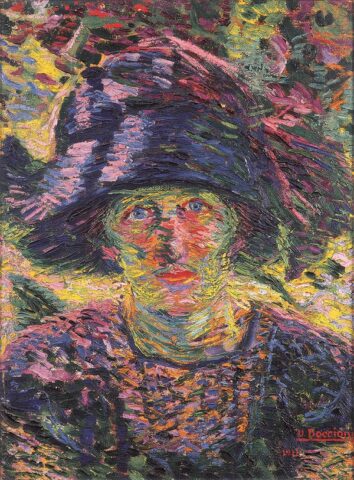 The exhibition begins with works created between 1903 and 1904 and leads the visitor through to the great formal achievements of 1911. These were years of intense work, during which Boccioni gradually moved from the Divisionist approach to the construction of a completely new language, capable of interpreting the modernity, movement, and dynamism that were transforming European society.
Accompanying this evolution is a core of fifteen works, built around the Futurist paintings preserved at MASI thanks to the historic donation from the heirs of Gabriele Chiattone, a collector, patron, and supporter of the artist during his Milanese years. These are complemented by important loans from museums and public and private collections, allowing for a particularly comprehensive reconstruction of a crucial phase in Boccioni's career.
Indeed, Boccioni's relationship with Gabriele Chiattone represents one of the most interesting aspects of the exhibition. Through the Milanese collector, Boccioni found a partner capable of supporting his research precisely at a time when economic and artistic difficulties seemed to be slowing his progress. Many of the works on display were born precisely within this dialogue, documenting a period of relentless experimentation.
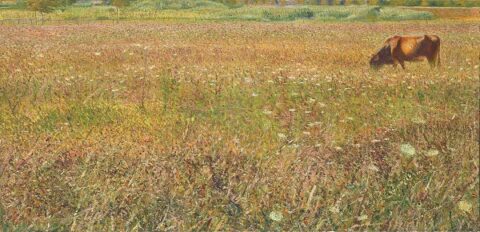 Landscape still dominates his early works. Countrysides, farmhouses, cultivated fields, and suburbs seem to belong to the tradition of Pointillist painting, but upon closer inspection, something different is already apparent. The brushstrokes begin to acquire rhythm, the light no longer simply describes reality but creates movement, while the spaces seem to gradually lose their immobility.
Works such as Roman Countryside or Noon , Lombard Countryside , Farmhouse , Peasants at Work , and Passing Train demonstrate how Boccioni was slowly abandoning naturalistic representation in search of an image capable of suggesting energy, tension, and transformation. Even a simple train becomes a symbol of modern speed, anticipating some of the themes that would characterize Futurism.
It's a research that proceeds by trial and error, without sudden leaps. The artist continues to question the role of color, light, and composition, but above all, how painting can transcend the simple imitation of reality to convey its inner strength.
Even when he tackles portraits or the human figure, the goal is no longer simply to describe a face. In works like Nude from Behind (Backlight) or Portrait of a Woman , light becomes an expressive medium, capable of transforming the subject into an emotional vibration rather than a physical presence. The environment dissolves, contours lose rigidity, and the figure seems to merge with the surrounding space.
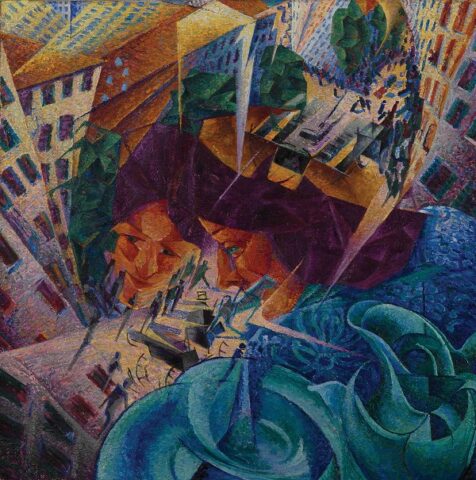
The true turning point came in 1911 with Simultaneous Visions , a work that marked Boccioni's definitive entry into the Futurist dimension. After his stay in Paris and his encounter with Cubist research, pictorial space fragmented, points of view multiplied, and reality was represented in its simultaneity. A single gaze no longer existed: the world was perceived as a set of energies in constant motion.
It is precisely this transition that the MASI exhibition highlights so effectively. Rather than celebrating Boccioni, already consecrated by art history, the exhibition explores the artist's creative laboratory, the years in which every certainty was questioned and each work represented a step toward a new idea of painting.
The result is an exhibition that is of interest not only to Futurist scholars, but to anyone who wishes to understand how an artistic revolution is born. Because before works destined for the textbooks, there always exists doubt, anxiety, exploration, and the courage to abandon what is known to pursue something that still has no name.