
 From September 6, 2026 to January 10, 2027, the MASI Lugano dedicates to Kaari Upson a vast posthumous retrospective that spans the entire production of the American artist, who passed away in 2021. Entitled Kaari Upson. Dollhouse, the exhibition brings together over fifteen years of research and offers a journey constructed through sculptures, installations, videos and drawings.
Also known to European audiences for her participation in the 58th Venice Biennale in 2019, Upson has developed a body of work in which the biographical dimension intertwines with broader issues: the relationships between people, the body, illness, loss, and the persistence of memories. Ordinary objects and domestic environments are subjected to transformations, deformations, and duplications, gradually taking on a meaning that goes beyond their original function.
The Lugano exhibition is curated by Francesca Benini and Taisse Grandi Venturi and is part of an exhibition project produced by the Louisiana Museum of Modern Art in Humlebæk , in collaboration with MASI and the Kunsthalle Mannheim. For the Ticino museum, it is the final stop on an international tour dedicated to the artist.
A journey through five chapters
The exhibition follows, to a large extent, the chronological development of Kaari Upson's research, dividing it into five nuclei: When Kaari meets Larry , The Life of Things , Dollhouse – a giant miniature , Interior Cartographies and Body, Memory and Fallibility.
The common thread is the artist's progressive approach to increasingly personal materials. While in his early works, the focus was on figures and places outside his direct experience, in later years his research shifted toward family history and finally to the artist's own body.
"Kaari Upson. Dollhouse, the first major posthumous retrospective dedicated to her, invites us to encounter an artist whose work continues to resonate even after her untimely death: disturbing, moving, and extraordinarily timely," observe curators Francesca Benini and Taisse Grandi Venturi.
 Larry, the neighbor transformed into a double
The beginning of the route takes the visitor back to the Larry Project , developed between 2005 and 2012 and considered one of the central nuclei of Upson's production.
The starting point is a real person: Larry, the artist's parents' neighbor in San Bernardino, California. In 2003, Upson entered his abandoned home and began collecting traces, objects, and materials linked to his presence. From that moment, the figure of the man gradually transformed into a territory of projection.
Larry becomes simultaneously a real subject, an imagined character, an alter ego, and a body upon which the artist constructs a complex reflection on identity. The line between what belongs to the man's biography and what springs from Upson's imagination becomes increasingly blurred.
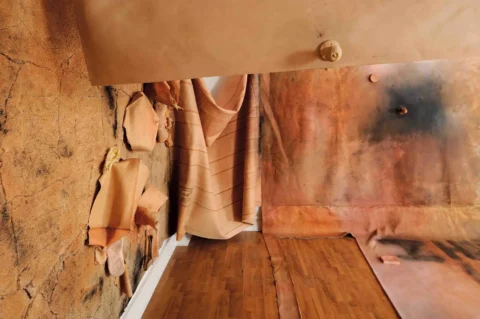
Among the works presented is Recollection Hysteria (2012), a large installation that reconstructs a room in Larry's home. The artist's process begins with latex casts, but the result doesn't simply recreate a space identical to the original. The walls, floor, and ceiling are subjected to a process of alteration and reversal, modifying the perception of the space.
In the Kiss Paintings series , created between 2007 and 2008, the relationship between Larry and the artist takes the form of a physical and pictorial overlap. The two faces end up intertwining, questioning the very idea of separate identities.
In the video As Long as It Takes – Part 1: The Head , Larry undergoes an even more radical transformation, while in Untitled (Charcoal Figures) from 2009, his figure appears as a charred presence. The project, developed over several years, thus also records the artist's attempt to confront an obsession until it is consumed.
Objects as archives of bodies
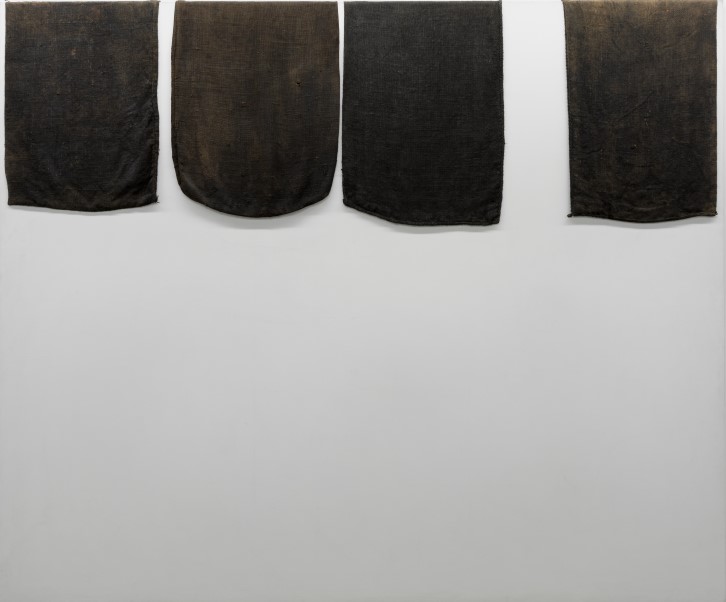
An important part of Upson's research concerns the ability of objects to retain traces. Mattresses, sofas, and other home furnishings are considered not simply functional elements, but surfaces capable of recording the passage and presence of bodies.
The Life of Things section features several sculptures created in the early 2010s using latex casts of old mattresses recovered from the streets of Los Angeles. Starting from these forms, Upson uses silicone, polyurethane, pigments, and other materials.
One example is 192 , a 2013 work in which the surface of a mattress features large, dark marks made with charcoal and pigments. What emerges is not a neutral reproduction of the original object. Instead, deformations and imperfections become an integral part of the process, hinting at a material memory that cannot be faithfully reproduced.
The dollhouse becomes an architecture of memory
The title of the exhibition refers to one of Kaari Upson’s most impressive works, THERE IS NO SUCH THING AS OUTSIDE , created between 2017 and 2019 and presented at the 2019 Venice Biennale.
For this work, the artist took as his starting point a dollhouse that belonged to his mother. The small domestic model was digitized and reconstructed in monumental proportions, transforming an object linked to childhood into a walkable structure.
The home, traditionally associated with a protected and private space, thus becomes the place where family tensions, gender roles, and time-honored dynamics emerge. The transition from miniature to large-scale installation also shifts the viewer's position, who no longer simply observes a model from the outside but becomes physically involved in the structure.
This is one of the moments in which the theme of doubling, a recurring theme in Upson's work, takes on a more evident dimension: the copy does not simply replicate an original, but produces a new space and new possibilities for interpretation.
From the family story to the artist's body
In the last years of her life, Kaari Upson's research focused more and more directly on her own experience and the relationship between the body, illness, memory and loss.
The "Body, Memory, and Fallibility" section features works in which figures overlap, fragment, and take on unstable forms. The artist's body interacts with that of her mother and with the places of her own family history.
Among the most significant works is Mother's Legs , an installation composed of numerous suspended forms resembling legs. To create them, Upson began with casts of her own knees and the shape of a tree that grew in her parents' garden, which was later cut down.
The result brings together corporeal and vegetal elements, childhood memories, and the transformation of matter. The reference to the mother is linked to the memory of a childhood perspective, when the height of her knees could still coincide with a place of protection.
The last series, left unfinished
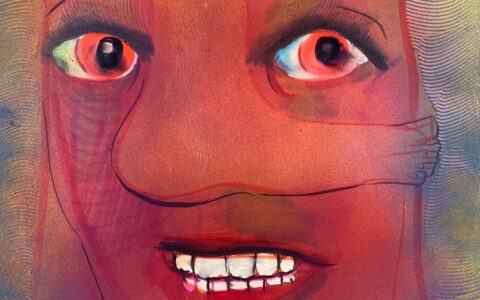
The retrospective also presents to the public for the first time Foot Face Paintings , the latest series created by Kaari Upson between 2020 and 2021.
The works, all on paper, revolve around a recurring subject: a wide-eyed face, partially hidden or covered by a foot. The project called for one drawing a day for a year, but was left unfinished due to the artist's death.
The 140 works, however, retain the structure of a daily recording. Taken together, they constitute a sort of visual diary of Upson's final months and conclude the exhibition by drawing attention to the relationship between repetition, time, and the fragility of the body.
An artist between Los Angeles, New York and major international institutions
Born in 1970 and died in 2021, Kaari Upson lived and worked between Los Angeles and New York. Throughout her career, she has had solo exhibitions at institutions such as the Hammer Museum in Los Angeles, the Deste Foundation in Athens, the Kunsthalle Basel, the Kunstverein Hannover, and the New Museum in New York.
He has also participated in major international events, including the 58th and 59th Venice Biennales, the Whitney Biennial, and the Istanbul Biennial. His work has also been exhibited in museums and institutions in the United States and Europe.
The MASI retrospective thus offers a comprehensive overview of a body of work that spanned just over fifteen years, interrupted by the artist's untimely death. From the first forays into Larry's abandoned house to his final drawings, the exhibition presents a research constructed through continuous shifts between individual experience and shared forms of memory.
The exhibition will be accompanied by an illustrated catalogue published by DISTANZ Verlag and edited by Francesca Benini and Taisse Grandi Venturi, with critical contributions from international scholars and curators.
For information on the exhibition and the museum's activities, please visit the official MASI Lugano website.