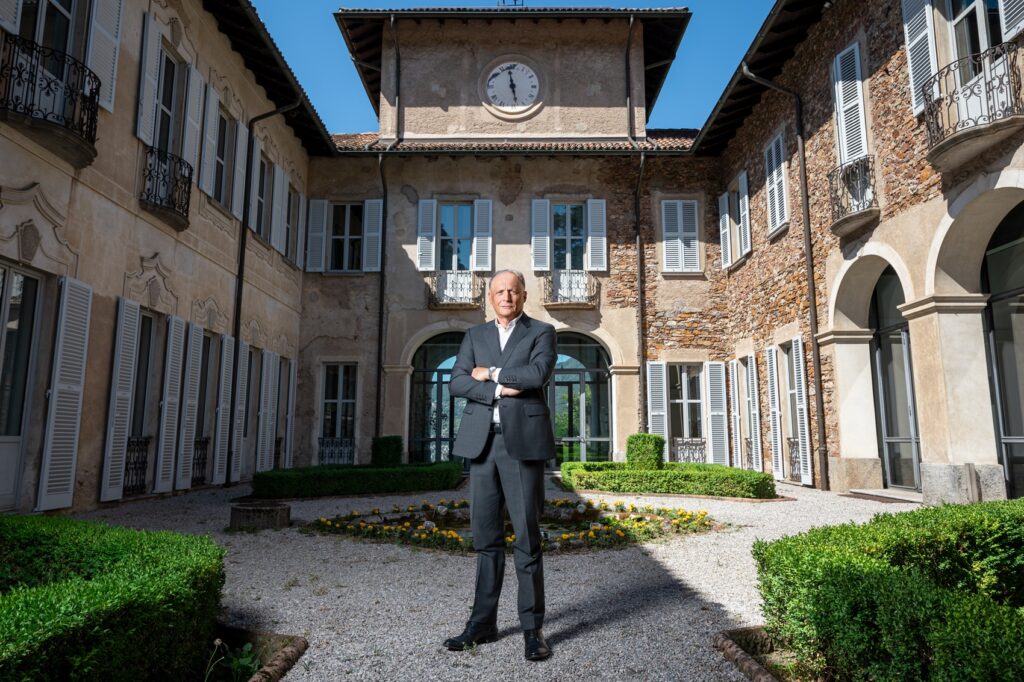

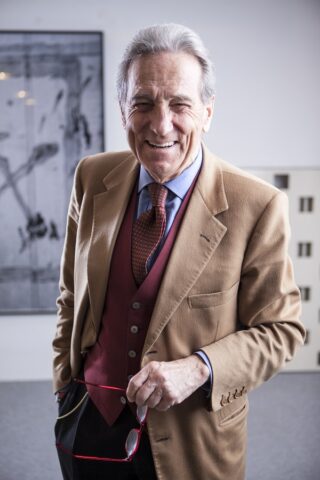
 Ticino loses a figure who, for several decades, spanned seemingly diverse yet profoundly intertwined fields: law, public life, culture, and collecting. The lawyer Giancarlo Olgiati He passed away last night in Lugano at the age of 88. The news of his passing leaves a void in Ticino's civil society and, in particular, in contemporary art, to which Olgiati dedicated a significant portion of his life.
Those who had the opportunity to meet him will also remember his open and immediate smile, capable of guiding conversations that could shift effortlessly from art to politics, from personal history to future plans. This human touch complemented the expertise and curiosity with which Giancarlo Olgiati navigated the world of culture for over half a century.
Son of Libero Olgiati, a prominent Ticino politician, Giancarlo Olgiati had forged a personal career that combined his professional practice as a lawyer with a constant focus on cultural life and societal transformation. He was considered one of Switzerland's most renowned art lawyers and, at the same time, one of the collectors who most contributed to making Lugano a hub for 20th-century and contemporary art.
An interest in art born in the 1960s
Giancarlo Olgiati's passion for art dates back to the 1960s. As a young lawyer, he began to explore contemporary art, developing an increasingly structured interest over time, fueled by encounters, studies, and relationships with artists and key figures on the international cultural scene.
It wasn't just the activity of a collector interested in acquiring works. In his case, collecting gradually became a journey of research, knowledge, and exchange. An attitude that would take on an even more defined form after meeting Danna Olgiati in 1985 at the SIMA in Venice.
As Giancarlo Olgiati himself explained to our artist Eduardo Grottanelli De'Santi in a long interview published by Ticino Welcome last June, that meeting occurred almost by chance, but it would profoundly impact his personal and cultural journey. Danna, then working as a gallery owner and already engaged in the study of the historical avant-garde and Futurism, would become not only his lifelong companion, but also a key figure in building his collection.
 The meeting with Danna and a shared project
Since the second half of the 1980s, Giancarlo and Danna Olgiati have developed a collecting project together that has grown over time. Their sensibilities were different yet complementary: on the one hand, Giancarlo Olgiati's interest in Nouveau Réalisme and contemporary art, on the other, Danna's studies of the historical avant-garde, Italian Futurism, and Russian artistic experiences.
In a previous interview with Ticino Welcome, Danna Olgiati recalled how their personal history and their cultural project were born simultaneously, to the point of becoming inseparable. The collection thus developed through shared work, grounded in research, dialogue, and the desire to build a collection capable of illustrating the connections between different periods of art.
A heritage that hasn't remained confined to the private sphere. It's precisely this choice to open the museum to the public that represents a fundamental part of Giancarlo Olgiati's legacy.
The Olgiati Collection and its connection with Lugano
In 2012, Giancarlo and Danna Olgiati decided to make their collection available to the city of Lugano, launching an exhibition project that would allow the public to experience works that until then had been the preserve of private collectors.
The Giancarlo and Danna Olgiati Collection , part of the MASI network and housed in the Riva Antonio Caccia spaces, represents the culmination of decades of research. The collection brings together over 1.200 works and includes sections dedicated to the 20th-century avant-garde, Spatialism, Arte Povera, and Nouveau Réalisme, as well as more recent neo-abstraction and neo-pop movements.
Over the years, the collection has been presented through various installations and temporary exhibitions, avoiding the idea of a fixed display. It is a constantly evolving collection, capable of constantly questioning new relationships between the works and establishing a dialogue between periods, languages, and artistic generations.
Projects presented over the years include, among others, exhibitions dedicated to the relationship between Yves Klein and Arman, the research of Enrico Prampolini and Alberto Burri, as well as projects built around works and artists from different periods of the twentieth century.

A collector, but also a protagonist of public life
However, reducing Giancarlo Olgiati to the role of collector alone would be incomplete. His biography was also deeply intertwined with the civic and political history of the Canton. The son of a family that had played a significant role in Ticino's public life, Olgiati had maintained a keen interest in political debate and the transformations of the city and its surrounding region over the years.
In the interview published by Ticinowelcome in June 2026, he retraced some of his experiences, also focusing on the role culture had played in Lugano's development and the birth of the hub formed by the LAC, the MASI, and the Olgiati Collection. He had been directly involved in the creation and growth of a cultural system.
His narrative evinced a vision in which art was not an isolated sector, but a component of a city's collective life and development. This also led to the decision, developed together with Danna, to share the results of a long research and acquisition process with the public.
A collection built as a research path
Over time, the Giancarlo and Danna Olgiati Collection has become a permanent fixture in Lugano's cultural life. The works were not conceived simply as a sequence of masterpieces, but as elements of a journey capable of forging connections between different artists and movements.
The exhibitions often highlighted the relationship between the historical avant-garde and contemporary art, juxtaposing paintings, sculptures, photographs, drawings, and installations. This approach reflected the two collectors' approach: observing art through continuities, ruptures, and references, without rigidly separating different eras.
The very presence of works linked to Arte Povera, Futurism, Nouveau Réalisme and more recent research testifies to the desire to build a broad collection, yet at the same time recognisable for the coherence of its choices.

The legacy of Giancarlo Olgiati
Giancarlo Olgiati's passing comes just months after the interview in which he lucidly retraced some of the key moments of his life. This testimony today inevitably takes on the value of one of the last direct accounts of his experience, his relationship with politics, art, and the city of Lugano.
Above all, what remains is the cultural heritage built over more than half a century and transformed, together with his wife Danna, into a resource for the community. This choice allowed a private collection to take on a public dimension and become a permanent part of Ticino's cultural fabric.
Giancarlo Olgiati's legacy will thus remain closely linked to the legal profession, the civic life of the Canton, and his long career as a collector. But the most visible legacy of his career lives on in the works he collected, studied, and shared with the public, the fruit of a passion that, from the 1960s until the last years of his life, never ceased to drive him.
The editorial staff's condolences
To his wife Danna , his lifelong companion on a long human and cultural journey, and to his entire family, we extend our most sincere condolences from the entire editorial staff of Ticino Welcome and our deepest condolences for the passing of the lawyer Giancarlo Olgiati.
In remembering him, we remain grateful for the dedication, passion, and commitment with which he contributed for decades to the cultural growth of Lugano and Ticino, leaving a legacy destined to continue over time through the Collection that bears his name together with that of his wife.