While others wonder if robots will make much of our workforce redundant, Scholes is confident that these profound changes will give rise to new ways of investing, and that future generations will benefit from these advances. As a Canadian-American, Scholes hopes for a united world in the future and opposes the idea of borders, convinced that the future will not be a place of "us versus them," but one where an open and free exchange of opportunities is possible.
Myron S. Scholes: A Man of Tomorrow
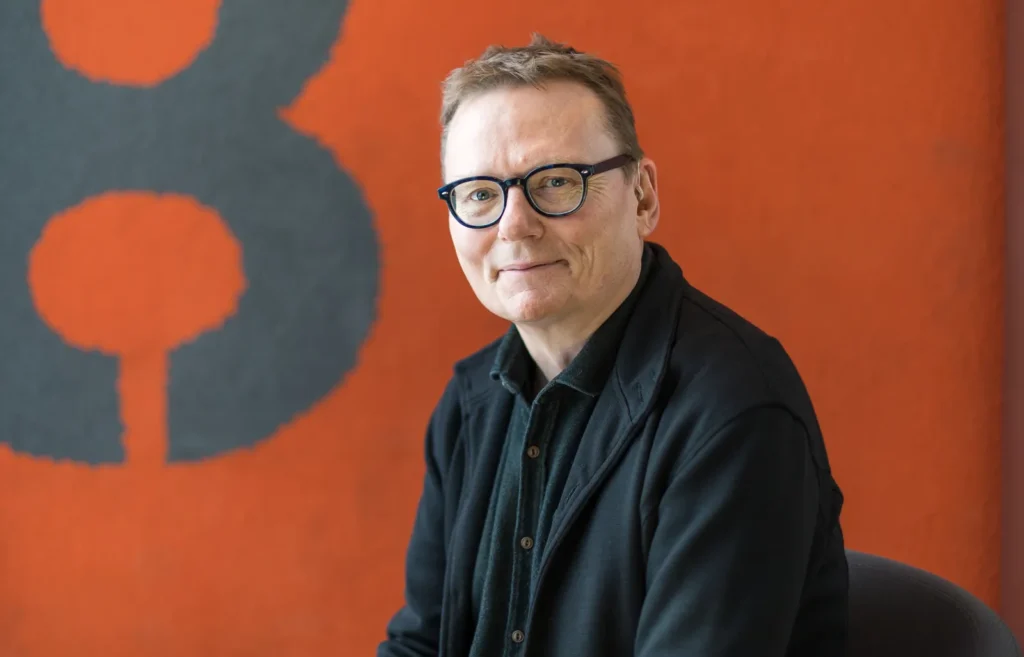
Myron S. Scholes is a truly handsome guy. He never leaves his office without sunglasses, even though he can't live without them due to a childhood eye condition that causes sensitivity to light. And when anyone compliments his looks, he responds with a wink, as if to say, "Yeah, baby."
Scholes is an eloquent speaker. He takes the time to explain things precisely, not just his experience in financial markets, but any topic he discusses. Because he's a man of tomorrow, the topics that most interest him recently are the future of investing and robots.
Robots aren't getting smarter
The media is buzzing with debate about artificial intelligence, fueled in part by fears that it could not only steal our jobs but also make humanity obsolete. Scholes scoffs at the idea: "Robots aren't getting smarter, they're just getting dumber!" According to Scholes, human-made technology will be limited to a very basic level, so much so that it can be customized, for example, by inserting a cell phone into a robot's brain. "Cloud computing allows software to modify the way a robot works, so it can perform different functions. This means more flexible and, therefore, less expensive operations."
Flexibility. Embracing change. These are words Scholes uses almost excessively when thinking about the future. Booking appointments via cloud sharing, working remotely from anywhere. And what's wrong with wanting to see our dream home 3D-printed before buying it, if that gives us the opportunity to optimize and customize it? It's clear that while many fear robots and new technologies, Scholes thinks the opposite and is enthusiastic about the opportunities they offer.
Scholes recalls a significant moment with one of his "great heroes," Milton Friedman. During a trip to Asia, the two economists saw farmers working in the fields with old-fashioned equipment. While Friedman was outraged by the backwardness and inefficiency of the labor, his point was clear: without those antiquated technologies, those farmers would be unemployed. Scholes laughs when he remembers Friedman telling him, "Then why don't you give them a hoe or a spade, and you'll go back to the most inefficient way of working imaginable and you can employ a lot of people!"
While Scholes laughs, he doesn't mean to imply that people's fears are unfounded. Our society will be forced to confront a completely new form of future interests. The World Economic Forum revealed that 65 percent of children starting primary school today will have a job that doesn't yet exist and for which they aren't receiving adequate training. "It's not a question of fearing technology," Scholes insists.
Will blockchain technology revolutionize financial markets?
Scholes emphasizes that the internet's shift from information transfer to value transfer will automatically bring a series of significant benefits for the next generation. The more trust in financial institutions and financial investments declines due to the recent financial crisis, the greater the likelihood that an imminent digital development will unlock the situation. Blockchain technology could be the financial revolution we've been waiting for. "We will all become the trusted person ," says Scholes. "Trust will come from verifying our transactions, just like when we want to go to a restaurant and search online for other people's opinions."
Crowdsourcing. A hope? A promise? The necessary turning point for a new generation to invest with more confidence? Scholes has no doubt that blockchain technology will make a huge difference and offers three reasons why it will help us solve old problems.
"It compresses time. If everything is done faster, it becomes harder to game the system. The second reason is that there's enormous value in doing personalized things. The transfer of value between individuals that we'll see in the future will allow us to do things in an increasingly personalized way because we'll have a wider range of options and therefore prices." The third reason cited by Scholes is flexibility. "It serves the individual. The more data you provide, the more data is provided, the more individuals will be involved. And the more individuals are involved, the greater the efficiencies achieved."
Should we fear international trade and globalization?
The fear people have about international finance and globalization today leads Scholes to pose interesting and unusual questions. For example, why do we always talk about global markets and international finance but not international emails? His comparison is amusing, but it highlights the benefits we all embrace—and then forget—when we imagine ourselves growing together as one. "When I send an email to someone in Germany, I don't think of it as an international email, but simply an email," says Scholes, still optimistic about the possibility that the world once defined by borders can become a single world defined by transactions.
But Scholes knows that not everyone benefits from globalization in its current form. Those who feel left behind are tempted by extremist parties, and this anger becomes fertile ground for populism. "In the old days, if there was a village, a moat was built around it. We weren't afraid of anything because the moat protected us. But then, unfortunately, foreign troops would arrive and destroy the entire town. Even though you might think you're protected in an isolated world, in reality you're never isolated because of the forces that surround you."
His analogy seems to hint at the political forces calling for the building of walls, but Scholes argues that the world is moving more toward a global village and the global exchange of securities and wealth than toward an “us versus them” situation.
Should we pay attention to those at the top?
To further explain the original problem, Scholes cites a movie to demonstrate that people focus on how well off they are compared to others. "A few years ago, I saw Titanic. Those on the upper deck were drinking champagne and listening to music while those on the lower decks were drowning or searching for lifeboats. In relative terms, those on the upper deck of the Titanic were better off, but they were definitely not well off."
Bringing the discussion back to finance, Scholes reiterates that the issue isn't about your relationship with those who dominate the financial world, but rather how you feel about the risk you're exposed to. "In investing, the most important risks are the tails of the distribution—those risks that are unlikely but occur frequently enough to impact your long-term experience." This is why Scholes used options markets and option pricing to understand what the market can tell us about the future distribution of risk and, hopefully, help shape future investment decisions.
The Black-Scholes formula: an indispensable tool for financial markets
The masterpiece of his academic career is the aforementioned Black-Scholes model for option pricing. In the early 70s, Scholes and Black created a formula for calculating the present value of an option and concluded that it was possible to value an option without actually knowing its expected return; all that was needed was to understand its volatility or uncertainty.
Naturally, the Nobel Prize-winning work was full of sophisticated mathematical analysis. Once the methodology was established, it became clear that it allowed for more efficient risk management and was a great help in protecting portfolios. Their model is still used today by investors around the world.
Scholes is confident that there will be enormous changes to the financial economy, including the very functions of finance, and believes that the power of the cloud and big data are driving better distribution that we can all benefit from.
Scholes smiles as he ends the conversation, as if the future were a Ferrari and he were about to jump aboard. Having made mistakes himself throughout his life, he has learned the most important lesson: sometimes you succeed, sometimes you don't. It's up to each of us to learn from these lessons. Win or lose, either way, you embark on a new adventure. Wearing his trendy sunglasses, Scholes bids us farewell, declaring, "That's life."
Myron S. Scholes
Date and place of birth : 1941, Timmins, Canada
Field of study : Financial economics
Award-winning work : A method for determining the value of derivatives, the Black-Scholes formula
Teenage hobby : Trading penny stocks of gold and silver with his mother
The worst aspect of the Nobel Prize : the limousine and the escort are only temporary.
A word of advice for life : go where the best are, go with the best, steal from the best, learn with the best. But to go with the best, you have to be the best yourself.