
 In an economic environment characterized by uncertainty and an increasingly rapid pace of change, the Canton of Ticino reaffirms its commitment to innovation and strengthening the competitiveness of local businesses. The Economics Division of the Department of Finance and Economic Affairs (FDEA) has presented an updated package of measures under the Law on Economic Innovation (LInn), which has been in force since 2015 and is already considered a unique model in Switzerland in terms of the breadth and structure of its measures.
The new provisions, presented in the presence of State Councilor Christian Vitta, expand the tools available to small and medium-sized enterprises, with particular attention to the experimental phase of projects and internationalization activities. Further details are available on the cantonal portal.
New incentives for technology transfer
Among the measures introduced, a new initiative stands out, designed to foster collaboration between Ticino companies and Swiss research centers recognized by Innosuisse. The goal is to support the development of applied innovation projects—whether product, process, or service—in their initial stages, which are often the most complex for SMEs operating in medium-tech sectors and requiring incremental innovation.
The measure provides a grant equal to 25% of the cost of the research mandate, up to a maximum of CHF 50,000 per project. The process is streamlined: once the access criteria regarding salary and resident employment have been verified, the evaluation focuses on the application's compliance. Monitoring is limited to two years or until the grant is paid.
Foreign trade fairs and markets: strengthened support
In the current global environment, characterized by intense competition and market instability, the LInn is also addressing internationalization. The measure dedicated to participation in specialized trade fairs—an often crucial tool for opening new sales channels and diversifying customer base—is being strengthened: the annual subsidy limit will be raised from 20,000 to 50,000 francs for the years 2026 and 2027.
An intervention that is part of the cantonal strategy aimed at reducing dependence on single outlets and strengthening the presence of Ticino companies in international circuits.
An ecosystem built on collaboration
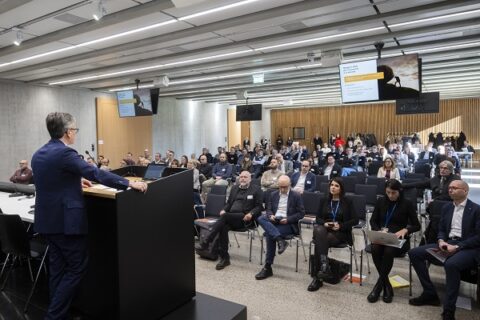
The presentation of the new developments took place at the USI-SUPSI East Campus in Lugano-Viganello, a symbolic location in the Ticino innovation ecosystem. Presentations by Luca Maria Gambardella (USI) and Emanuele Carpanzano (SUPSI) offered concrete examples of partnerships between research and business, reaffirming the value of interaction between academia and the productive sector.
In their closing remarks, the representatives of the economic associations—Nicoletta Casanova for AITI and Cristina Maderni for Cc-Ti—also highlighted how structured collaboration between institutions, research, and businesses is one of the pillars of the cantonal model.
 A long-term strategy to support Ticino SMEs
The new measures are covered by the 2024-2027 framework credit approved by the Grand Council in December 2023. This initiative expands an already extensive range of incentives, which over the years has helped Ticino become one of the top ten most innovative regions in Europe and second in Switzerland, surpassed only by Zurich, according to the European Commission's latest analysis.
With these new developments, the Canton confirms its commitment to consolidating its international presence and offering increasingly targeted support to Ticino SMEs, combining innovation, research, and the development of new markets.
For all images:
© Ti-Press / Samuel Golay