
What was the path that led you to deal with the possibilities of using solar energy?
After graduating from high school in 1994, I studied jazz saxophone in Boston, Lausanne, and Paris until 1997, intending to pursue a career as a professional musician. Between 1997 and 2003, I also earned a master's degree in theoretical physics from the University of Bologna. As a consultant for the Ticino Chamber of Commerce, I then prepared an expert report on alternative energy drives in road traffic, where I focused primarily on hydrogen technology. After a stint in industry, during which I was technical director of the newly established RFID department at Finser Packaging SA, I began a doctorate at ETH Lausanne in 2007, which I completed in 2010. From 2011 to 2015, I led a research group at Airlight Energy, a solar energy company. This very important experience unfortunately ended with a change in management and the company's strategy. Finally, in 2016 I co-founded the company Synhelion ».
What are the purposes of this company?
Synhelion aims to replace fossil fuels with economically viable synthetic fuels, compatible with the current global fuel infrastructure, and reduce net CO2 emissions by up to 100% . Synhelion's solutions combine state-of-the-art solar tower systems with proprietary high-temperature thermochemical processes for the production of solar fuels.
On the basis of what processes do you propose to produce fuel from the air and the sun?
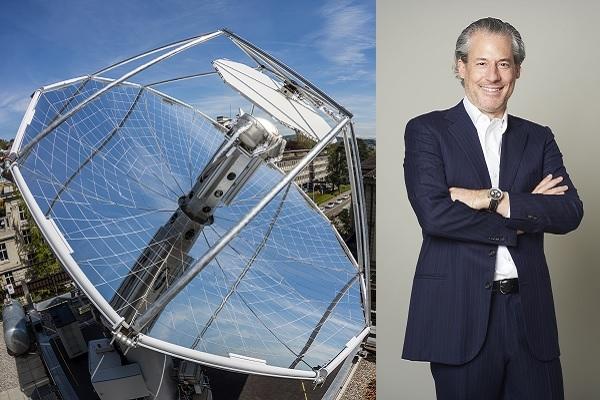
«The experimental plant on the roof of the ETH Zurich produces a fuel developed from water and CO₂. Already today, in principle, this fuel can be used like petrol to fill the tank of a conventional passenger car. The plant obtains the necessary carbon dioxide CO₂ and H₂O from normal air. The system separates the water contained in the ambient air and the CO₂ in a specially developed nanotechnological filter. Once separated, the system conducts both elements into a ceramic solar reactor, capable of withstanding extreme heat. By means of a parabolic mirror, pure solar energy heats the mixture of water and CO₂ to 1500 degrees Celsius. Subjected to these high temperatures, water and CO₂ are converted into a mixture of hydrogen-carbon monoxide, which in the following steps becomes gasoline, kerosene or methanol ».
Does the production of these fuels cause emissions that are harmful to the environment?
«The new synthetic fuels appear to be almost neutral from the climate point of view, apart from the - little - gray energy needed to produce the solar thermal system. In fact, during the combustion of the fuel, only the quantity of CO₂ taken from the air for production is released. The rest of the "exhaust gases" is water. In addition, the existing global infrastructure, ie pipelines, refueling stations, engines, etc., is also suitable for the distribution, storage and use of new solar fuels ».
Is it possible to make a forecast about the time needed to bring these fuels to market?
"The production of our solar fuel is still very expensive taking into account the fact that, on the other hand, the current price of fossil fuels does not include the external environmental costs to reduce or even avoid CO₂ and other harmful substances that cause air pollution and global warming. Sustainability must be seen as a long-term investment that future generations in the form of an environmentally friendly energy supply system. Synthetic fuel cannot therefore yet compete with traditional petrol and kerosene in purely economic terms. The goal is now to bring the technology to an industrial level and become competitive. To this end, Synhelion works with the support of the Swiss Federal Office of Energy and another leading partner. The technology will still need a couple of years to be able to produce more economically. Commercial production will therefore be possible as soon as possible at the beginning of 2022 ».