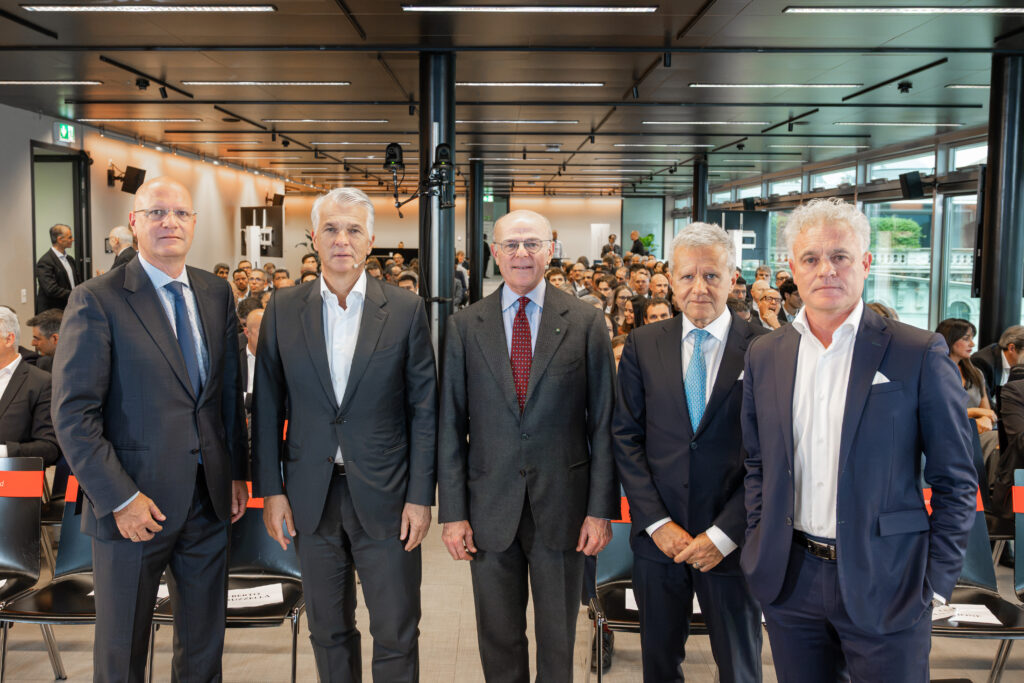

Interview with Sir Christopher Pissarides, courtesy of UBS Nobel Prespectives
Anyone who has ever looked for a job knows that it is a very long process. You need to read the adverts, prepare the applications and send them. And then the waiting begins. Sometimes you get an interview, then you have to wait some more and probably do more interviews. Meanwhile, on the other front, employers face a similar search process to find the perfect candidate for their needs. Unemployment and job vacancies coexist in almost all economies.
If this may seem obvious to us today, it is only thanks to a Cypriot economist called Christopher Pissarides, who arrived in London in the 1970s and turned the view of the labor market on its head. Fascinated already as a child by the work of the people around him, and driven by the profound social awareness that characterized the end of the Sixties, Pissarides undertook an independent study of unemployment and proposed, with his work, a model of radically new structures to understand the classic labor market.
The meeting between supply and demand is just a matter of human connections
“My fascination with economics has always been with the job market, because that's where people interact,” says Pissarides. «This interaction, in fact, does not only concern the pure economic interaction in which one enters to produce, obtain an income and then exit, but above all the actual connection between people in the labor market, the importance of being well matched.
I have tried to distance myself as much as possible from the very cold approach of economists towards work, while at the same time maintaining existing economic modeling principles. How far can these principles that saw the light of day with Adam Smith about 250 years ago and have evolved over the centuries take us? They can explain some things and get others wrong."
His work, for which the Nobel Committee awarded him the prize in 2010, manages to bridge this gap through the integration of the classical market model with the research function, bringing the supply and demand aspects of economics classical to the point where they can help explain how labor markets work. The study appropriately integrates the characteristics of Pissarides' search theory, where potential partners search for each other – just as happens on dating or real estate search sites – before starting an interaction.
In essence, Pissarides added a third equation, the matching equation, to those existing in the labor market model. This turned out to be a great insight, determining much of the future research and policies on work, housing, lending and other economic market activities that require matching.
The beauty of mathematics
As he takes us on a journey that takes him back to his childhood in Cyprus, Pissarides reveals his way of relating to the world around him, recalling how fascinated he was by the simple and elegant motifs embroidered on handkerchiefs by the women of Cyprus. The young future Nobel Prize winner was fascinated by the process of transformation through work, by these women who took a simple silk thread and returned to their father's clothing shop with the finished product. Starting from raw materials, the worker not only creates a new object, but also gives it value through the act of production.
It is not surprising that Pissarides speaks in a similar way about mathematics, where something concrete emerges from an initial distancing from the subject. “It's more about abstraction, beauty, and his way of producing results quickly,” says Pissarides. “You have an equation, you solve it, and there you go. In a way it's like a language, but much more tangible." Pissarides considers the elegance and simplicity of mathematical modeling to be a useful path to solving essential social problems.
Determined to understand unemployment
In the few years he initially spent in the UK, long before he was knighted by the Queen or won the Nobel Prize, Pissarides saw what unemployment was and felt determined to understand it better. His research introduced the value of the unemployed worker.
“When I realized that there were people who wanted a job but couldn't get it even though companies were hiring, I clearly saw the great lack of understanding of the problem and what could be done to solve it.”
The value of the unemployed worker
The concept of the value of the unemployed worker as a potential labor market income earner in exchange for his skills – and therefore a stagnant source of economic activity – aroused compassion in the economist, but also sparked his curiosity. This idea has radically improved our ability to understand (mal)functioning in the labor market and contributed to the review of related policy recommendations. As he progressed with his studies, Pissarides felt an awareness awaken that stimulated his curiosity and led him to find a solution. During the years of Margaret Thatcher's government in the United Kingdom, unemployment skyrocketed. “Some market reforms were of great help to Britain, but I would have done things differently.” First, the reforms would have been implemented much more gradually, and second, Pissarides would have defined the policies in consultation with the union representatives. Finally, the workers affected by the reforms would not have emerged so damaged.
Shortly after the announcement of his Nobel Prize, Pissarides had several opportunities to influence policymaking. He was a consultant to the Cypriot government and the European Council. «When you give advice to a politician, you should never expect him to do what you tell him. That would be extremely frustrating. The most you can hope for, when you work as a consultant to politicians, is that they will listen to you."
“Until he was awarded the Nobel, he always had the feeling of not being taken seriously,” says Rachel Ngai, Pissarides' partner in life and work, who recalls how he has always been a true academic, focused on his studies regardless of the awards .
The hope that some of the things he says will take root and influence decisions and policies is what keeps Pissarides going. In addition to his inability to stand by and watch when he knows what needs to be done. “I would never give up just because they aren't listening to me,” he says. "I'll move on and then who knows, maybe one day they might decide to listen."
It was precisely the principle of never giving up that led Pissarides to intervene in the Eurozone crisis. Given his deep interest in both the European project and unemployment, he began to lecture, disseminate his ideas and organize campaigns to inform Greece and Cyprus. This was after 2008, when the average unemployment rate was approaching 30 percent and half of young graduates couldn't even set foot in the job market.
How to solve the crisis in Greece?
“If we think back to the policies that caused this market failure and the increase in unemployment, they are not very different from those we had during the Great Depression,” explains Pissarides, referring to John Maynard Keynes regarding the investment policy of governments. «The other reason concerns the high level of debt. Institutions that could provide financing to Greece to carry out its economic policies insisted that the government cut wages, pensions and spending, measures that reduced the level of demand in the economy."
Neoclassical economists argued that cutting wages would reduce labor costs and make the country more attractive as a producer of low-cost exports. “We saw that it wasn't working,” Pissarides recalls. «One of the reasons is that exports to Greece are not very developed. The tourism sector is very large and is the example that is always cited. If the Greek tourism product becomes much more convenient because now you don't have to pay a lot of money to go to a local restaurant or hotel, many more tourists will visit Greece. But in reality this idea didn't work. Even if the numbers increase, they are not enough to revive the entire economy."
«I am convinced that if within the Eurozone we are true partners and create a real partnership, then the other Eurozone countries, led by Germany, should decide to invest in Greece today, to take advantage of the excellent investment prospects».
Pissarides' unshakable optimism accompanied him for much of his life. When he came to study in London at the age of 17, he immediately realized that in a new country the context tends to change, and over time what seemed difficult becomes manageable and in the end even pleasant. "I never give up! If I started doing something I could never give it up, regardless of the difficulties. But I'll do it my way." Pissarides summarizes his entire experience in this advice.
What is the lesson of Pissarides' work?
«The orthodox approach treated labor like any other commodity that can be bought and sold at market prices. Anyone who works in the financial sector knows that this is absurd."
Sir Christopher Pissarides at first sight
Date and place of birth: 1948, Nicosia, Cyprus
Field of study: Labor economics
Nobel Prize Winner for: Analysis of Market Frictions
Favorite books: Biographies, especially of successful people
Superpower: Can distinguish a river stone from a sea rock
He made history: he is the only person to be twice denied a promotion by the LSE
Architectural contribution to the LSE: he insisted on building a bridge connecting the economics faculty with the research centre
Mantra: “I never give up!”