
 The Italian Design Day returned to Zurich for its tenth Swiss edition, with a program dedicated to design culture, manufacturing, and economic relations between Italy and Switzerland. Yesterday's event—September 21, 2026—focused on Italian-Japanese designer Isao Hosoe, the protagonist of the exhibition held at the Museum für Gestaltung in Zurich from September 17 to 27. The initiative is part of the broader Zurich Design Weeks calendar and represents, for the second consecutive year, Italy's participation in the event.
Promoted internationally by the Ministry of Foreign Affairs and International Cooperation and the Ministry of Culture, Italian Design Day was created with the aim of bringing Italy's design and manufacturing heritage to major foreign markets. In Switzerland, the event is organized in collaboration between the Consulate General of Italy in Zurich and the ICE Office in Bern (the Italian Trade Agency).
Italian design in Switzerland: between culture and market
The Zurich event was not limited to the presentation of products or companies. The theme chosen for this edition, RE-DESIGN. Regenerating spaces, objects, ideas, relationships , emphasized the role of design as a tool capable of influencing the ways of inhabiting, producing, and interpreting contemporary spaces.
This perspective found concrete expression in the work of Isao Hosoe, a designer born in Japan who moved to Italy, where he developed a long career working with companies and designers. His experience represents a meeting point between two distinct design traditions, united by their exploration of form, function, and innovation.
The exhibition dedicated to Hosoe, held at the Museum für Gestaltung, is the centerpiece of the 2026 edition. The choice of the designer takes on particular significance within the theme of the event: his professional path allows us to observe design not only as the production of objects, but also as a process of cultural contamination.
 Isao Hosoe, a journey between Japan and Italy
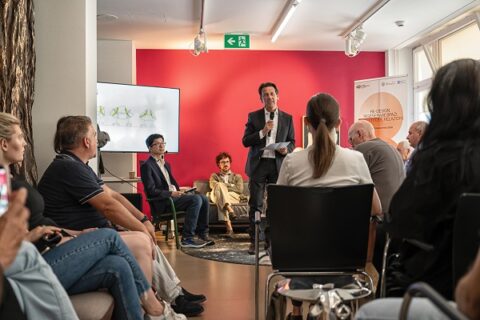
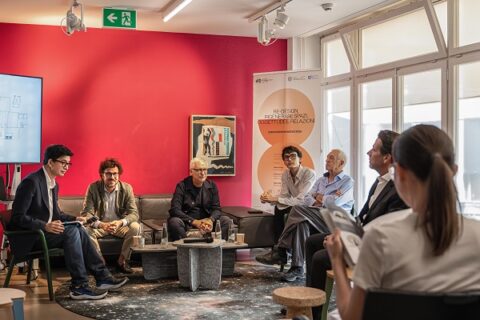
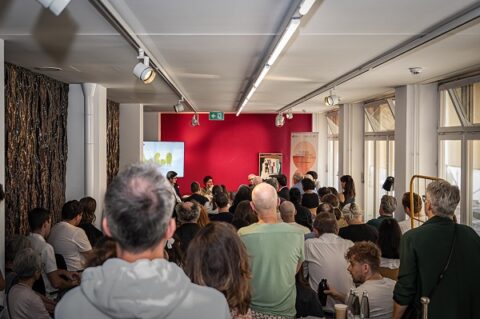
It is precisely the relationship between the two cultures that was explored in the talk Celebrating Isao Hosoe: A visionary bridge between Japanese culture and Italian design.
The debate was attended by Francesco Zurlo, dean of the School of Design at the Milan Polytechnic, Werner Zemp, a Swiss designer and artist, and Lorenzo De Bartolomeis, curator of the exhibition and designer of the Hosoe studio.
The meeting was introduced by the Consul General of Italy in Zurich, Mario Baldi, and moderated by Taro Hosoe and Alessandra Salvin, the project's Swiss curators.
The comparison allowed us to retrace Hosoe's professional career, highlighting the transversal nature of his work . His figure was interpreted as a link between Japanese formal sensibility and Italian manufacturing tradition, in a journey in which design and industry maintained a constant relationship.
The theme of regeneration proposed by Italian Design Day thus finds expression in design's ability to connect different cultures—not just through objects, but through the processes, skills, and methods by which a project is conceived and subsequently transformed into a product.
 From design to manufacturing
One of the key points that emerged from the initiative concerns the relationship between creativity and the production system. Italian design continues to be closely linked to the manufacturing capabilities of companies, a network of specialized skills, and the ability to transform design research into products destined for international markets.
This model is particularly relevant in Switzerland, where Italian furniture has long enjoyed a consolidated presence. Numerous companies in the Swiss market offer Italian-made furniture, lighting, accessories, and interior design solutions, with a particularly visible presence in the Canton of Ticino.
The relationship between the two countries is therefore not limited to the cultural dimension. This sector also represents a significant segment of bilateral trade.
The economic weight of the home furnishings sector
According to data presented at the event, Italy is Switzerland's second largest supplier in the sector, after Germany, with an estimated market share of around 14%.
The sector's total trade is estimated at approximately €1,2 billion. Within this figure, furniture, lighting, and prefabricated buildings account for over 60% of Italian exports to the Swiss market.
These numbers help place Italian design in a broader perspective than just a purely cultural one. The presence of Italian products on the Swiss market is linked to a demand for both design quality and the ability of companies to offer innovative solutions.
The topic of sustainability is also taking on a growing importance in this context. The demand for long-lasting products, more responsible materials, and production processes capable of reducing environmental impact is progressively transforming the furniture sector. The RE-DESIGN concept proposed by the 2026 edition is therefore part of a transformation that affects design, production, and consumption as well.
Zurich as a meeting point for European design
The decision to integrate Italian Design Day into Zurich Design Weeks also allows the Italian initiative to be included in a broader program dedicated to design culture.
This is Italy's second consecutive year of participation. Its presence in Zurich allows for networking between institutions, designers, companies, curators, and professionals in a sector where the international dimension has become a fundamental element.
In this context, Italian Design Day serves a dual purpose. On the one hand, it maintains a cultural component, through exhibitions and in-depth events dedicated to the protagonists of the history of Italian design. On the other, it represents a tool for economic promotion for a sector in which relations with foreign markets are an important part of the supply chain.
The Swiss case is particularly significant due to its geographic proximity and the size of trade. Furthermore, in the Canton of Ticino, the connection with the Italian furniture industry is further strengthened by its proximity and the presence of specialized operators.
A dialogue that goes beyond the object
The tenth edition of Italian Design Day in Switzerland therefore used the figure of Isao Hosoe to address a broader question: what role can design have today in a society in which spaces, needs, and relationships between people and objects are changing.
The solution proposed through RE-DESIGN doesn't just involve designing new products. The term also evokes the possibility of intervening on existing things, modifying their function, meaning, or relationship with their users.
From this perspective, Hosoe's career becomes particularly significant. His professional journey combines diverse cultural experiences and a direct relationship with the Italian industrial system, demonstrating how design can develop through the intersection of diverse skills and sensibilities.
The Zurich event thus brought back to the forefront one of the historic hallmarks of Italian design: the ability to navigate between culture and industry, research and production, identity and fusion. A relationship that, in the Swiss market, also finds a concrete and measurable economic dimension.
In this sense, the exhibition at the Museum für Gestaltung and the talk dedicated to Isao Hosoe represented two complementary moments of the same initiative: on the one hand, the valorization of a figure and a design path, on the other, a reflection on the future of a sector called upon to confront new production, environmental, and social needs.