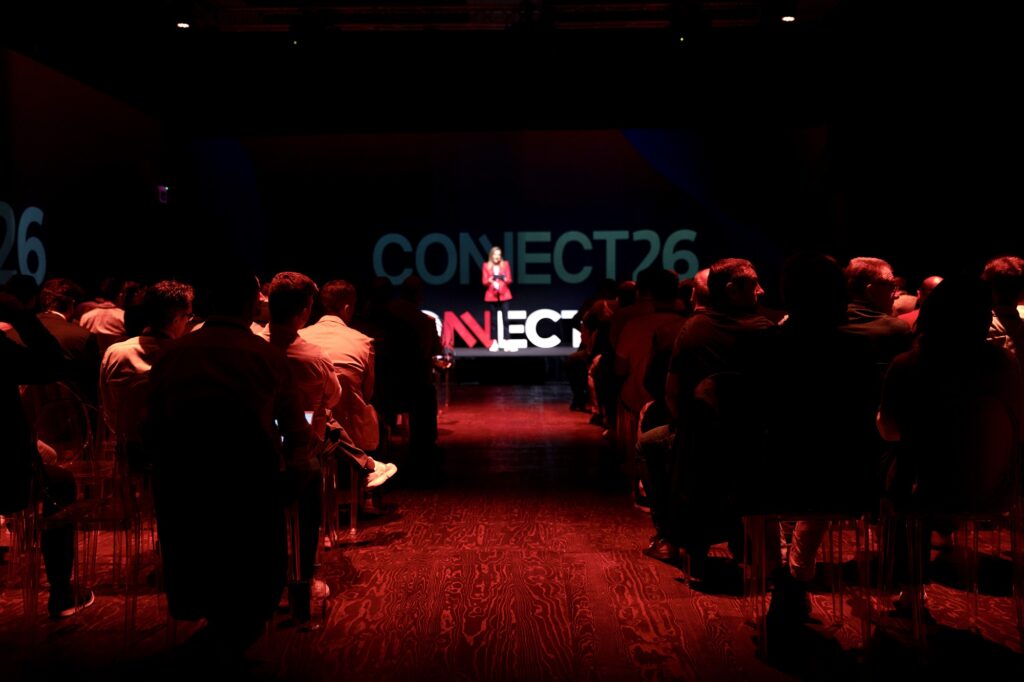
 Innovation, for a small business, doesn't necessarily mean introducing a new technology or making a radical investment. It can also start from an existing skill set, a process that can be rethought, or an internal resource that has so far been marginalized in development strategies. It is from this perspective that Fondazione Agire has created the new edition of Action Day Evolution, an event dedicated to Ticino companies that took place on September 9th at the Conza Pavilion in Lugano.
The numbers first reveal the composition of the audience: approximately 100 attendees in total, 90 workshop participants, and 66 companies represented. This figure is particularly significant given the size of the companies involved. Four out of five companies, in fact, have fewer than 50 employees.
The event, supported by the Economics Division, AITI, and the Regional Development Agencies, this year chose to depart from the traditional format of an innovation event, which primarily features presentations and testimonials. The program focused more on the direct work of participants, with the goal of transforming the topic of innovation from a topic of discussion to an exercise applied to individual companies.
Micro and small businesses in the spotlight
The distribution of participating companies offers an interesting snapshot of Ticino's economic fabric. Of the 66 companies represented, 56% employ between one and nine people, while 24% employ between 10 and 49 people. The remaining 20% consist of companies with between 50 and 249 employees.
The prevalence of smaller businesses is not a secondary factor. For micro and small businesses, undertaking structured innovation processes can mean dealing with time constraints, financial resources, and specialized personnel. In this context, leveraging existing resources can be a more immediately viable option than seeking entirely new solutions.
The new Action Day therefore attempted to shift the focus from the question "what technology should we introduce?" to a broader question: what development opportunities are already contained within the organization and have not yet been exploited?
The LEGO® Serious Play® method as a working tool
A central part of the day was dedicated to the workshop based on the LEGO® Serious Play® method, used to help participants represent and analyze their own corporate reality.
The work focused on skills, resources, and processes, with the aim of highlighting elements that can become levers for new development paths. The choice of an experiential approach also changes the role of participants: they are no longer simply listeners of business cases, but are called upon to directly question and interpret the functioning of their own businesses.
The topic was included in the broader concept of the so-called "Third Way of Innovation," addressed during the day by Michele Budri, Agile Coach, Trainer, and consultant at Essere Agile, and Carlo Spellucci, Lead Facilitator at Rasmussen Consulting.
The discussion therefore didn't focus exclusively on emerging technologies. The starting point was rather the relationship between organization, people, skills, and adaptability.
Artificial Intelligence and Skills Transformation
The topics discussed also included the impact of artificial intelligence on work and the skills required by companies.
Matteo Nembri, CEO of Nembri Silk, and Christian Burkhalter, Global Head of HR / Digital HR Transformation at Casale and President of AgileLAB Ticino, shared their experiences. Their two speakers offered different perspectives, but they both addressed the same issue: technological innovation inevitably changes the way organizations utilize and develop their people's skills.
This is a particularly important step for SMEs, where the introduction of new tools can rapidly impact tasks, internal processes, and the distribution of responsibilities. Artificial intelligence, in this sense, is not simply considered a technology to be adopted, but a factor destined to transform the organization of work.
Giorgia Pati, Innovation Manager at AITI and head of the new AITI4Innovation service, also spoke on the topic of innovation opportunities, bringing the Ticino economic association's perspective to the meeting.
A comparison that crosses different sectors
Another aspect that emerged from the composition of the participants was the diversity of the businesses represented. The ICT and tech sector accounted for 29% of the companies present, followed by business services at 15% and manufacturing and production at 12%.
Alongside these sectors, there are companies active in healthcare and pharmaceuticals, trade and retail, construction and plant engineering, logistics and transportation, as well as numerous other activities.
Such a diverse presence allows us to compare problems that, while belonging to different sectors, may have common elements. Skills management, process organization, the exploration of new markets, or the use of digital tools are not exclusive to technology companies.
For a manufacturing company and a service company, for example, the nature of innovation may be very different, while the need to identify unused resources or make certain processes more efficient may be similar.
From presentation to work between companies
Andrea Barni, Project Manager of Action Day Evolution and head of the SME sector at Fondazione Agire, explained that the change in format stems from the desire to move beyond the event model, which is primarily based on presentations and testimonials.
"We wanted to take a step forward from the traditional innovation event," Barni said, citing direct interaction between participants as one of the key elements of the new approach.
Alongside the workshop, working groups were organized to foster discussion among companies. This approach aims to transform networking from an incidental aspect of the event to an integral part of the process.
The opportunity to engage with companies from different sectors can, from this perspective, become a tool for identifying approaches and solutions that aren't immediately visible within one's own sector.
Innovation as an internal process
The decision to focus on existing resources within companies also reflects one of the Agire Foundation's lines of intervention. President Stefano Colombo emphasized that innovation doesn't necessarily mean starting from scratch or chasing the latest available technology.
Skills, knowledge, and resources accumulated over time can form a foundation upon which to build new projects. For smaller companies, this approach can be particularly significant, as it allows them to consider development based on existing capabilities, even before considering new investments.
The role of the Agire Foundation is therefore described as supporting local businesses, in collaboration with trade associations, offering tools and opportunities for discussion.
This approach takes the topic of innovation to a less abstract level. It's not just about identifying the latest technology, but understanding whether and how a company can transform what it already has into a new opportunity.
An appointment that looks to 2027
The 2026 edition of Action Day Evolution concluded with a format that prioritized direct engagement over content delivery alone. The participation of 66 companies, with a clear predominance of micro and small businesses, also offers an indication of the audience for initiatives of this type.
It now remains to be seen whether the reflections and tools tested during the day will translate into concrete initiatives within individual companies. This, after all, is the measure by which an event dedicated to innovation can be evaluated beyond the number of participants.
The next event has already been scheduled: the fifth edition of Action Day will be held in Lugano on Tuesday 14 September 2027.